
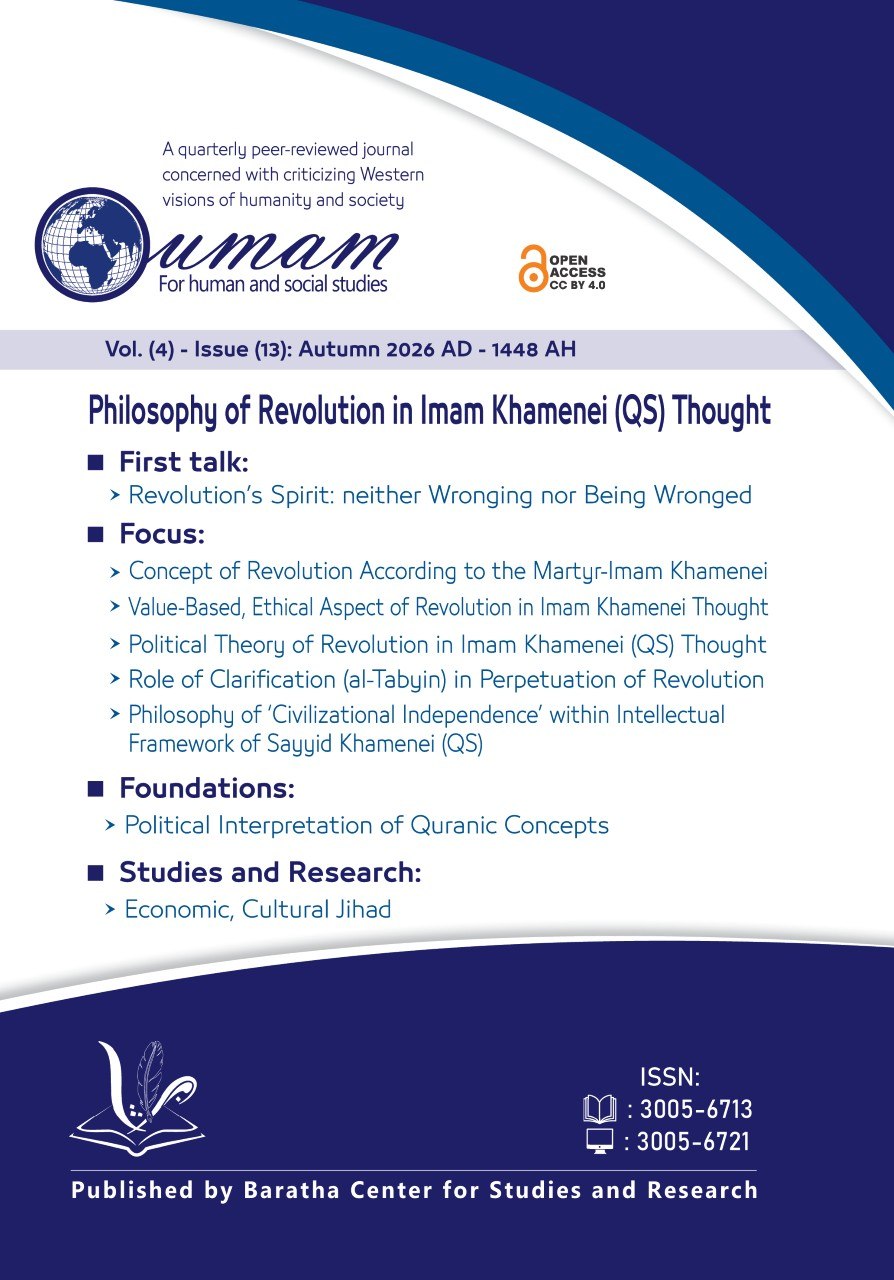
This has imbued the concept with a political and economic character, leaving unresolved questions regarding the spirit, purpose, and destiny of revolution: Why do revolutions age and wither? What connects them to the human essence, to human meaning, values, and destiny? A purely materialist concept cannot answer these questions. The revolution manifests in various forms within the human experience: political revolutions that topple one regime and establish another; social revolutions that transform the structure of society; and intellectual revolutions that alter humanity's perception of itself and the world. Yet, the common thread linking these forms remains elusive. What truly defines a movement as a revolution, and what distinguishes it from mere fleeting unrest or a simple transfer of power? This is an age-old question, the answers to which have been shaped by entire schools of thought within modern political theory.
Many of these schools have viewed revolution through a singular lens, reducing it to a shift in the balance of power or a materialist inevitability governing the course of history. In doing so, they have displaced the human being from the ...
He took into account that the division of titles should be based on principles that serve its purpose, so he began with an approach of a conceptual nature that addressed the linguistic and terminological dimensions. The purpose of this is clarification. After that, he moved on to talk about the movement of the concept in the Islamic world, where he worked to monitor its arrival and the mechanism of dealing with it, arriving at the third title, which is the revolution according to Imam Khamenei (QS). He defined his concept of revolution and compared it to Western thought. Therefore, he showed its specificity and its pillars, and through this comparison, he showed the uniqueness of the Imam's vision. The research concluded with a socio-political reading of the term, and concluded with a conclusion that showed the results reached by the research.
...Despite the harsh effects of the economic blockade on the people, and the many wars that the Islamic Republic has gone through, but it is a test, in which the values and ideals of the religious and political leadership were tested. In order to answer the question: Can the Iranian leadership be forced by political and economic circumstances to give up its moral and humanitarian values, or at least is it possible to compromise on them?
I believe that Imam Khamenei's (QS) history of struggle, intellectual depth, and the knowledge, experience, and faith he possesses make it difficult to accept the notion that such values and fundamental principles of the Islamic system could ever be relinquished. These are matters of principle, religion, faith, and morality, which do not permit the system to compromise them under any circumstances. Rather, adversities only serve to strengthen its resolve and reinforce its steadfastness and determination to defend those values and moral ideals, even if the price to be paid is martyrdom.
...It presents Sayyid Khamenei's (QS) distinctive conception of the Islamic Revolution as a global civilizational project while preserving its Iranian cultural and historical specificity. It distinguishes between the revolutionary state and the traditional state based on fundamental criteria relating to continuous dynamism, the revolutionary spirit within institutions, and the doctrinal relationship between the leadership and the masses.
The study proposes a conception that combines divine sovereignty as the ultimate source of legislation with popular sovereignty as the nation’s right to choose its system of government, through a distinction between legislative sovereignty and executive sovereignty. It also addresses the challenge of reconciling doctrinal constancy with the requirements of state governance by distinguishing between immutable principles and variables, as well as between negative justice and positive justice. The study concludes that Sayyid Khamenei's (QS) thought constitutes a substantive contribution to contemporary Islamic political thought.
...Clarification, which the leader considers an essential part of the strategies of revolutionary action since the beginning of the revolution, increases in value and necessity the more these attempts intensify, targeting the minds of the people with the aim of eliminating the people's beliefs, principles, and revolutionary spirit that motivates the rejection of hegemony and arrogance. As for the revolution, a continuous movement does not end until it achieves its noble goals and great effects. However, in order for it to continue and endure, it requires conscious and effective clarification based on intellectual and practical principles. In this research, we will discuss the principles of clarification and its path in human life, and then we will move on to explaining the practical map of this intellectual jihad in a way that achieves the sustainability of the revolution.
...This vision is based on the universal reference of the Qur'an, the basis of which is monotheism. Therefore, the goal of Islamic civilization will be to build man and meet his material, moral, and spiritual needs at the same time.
Sayyid Khamenei (QS) aspires to achieve civilizational independence, first and foremost through the production of culture, as well as through the entrenchment of scientific and intellectual values, university curricula, the dissemination of ethical and humanitarian values, the economy, the development of defence capabilities, and political values; in short, by avoiding dependency in all spheres of life.
From this perspective of civilizational independence, Sayyid Khamenei (QS) simultaneously emphasizes unity with other Muslim peoples and states in order to achieve political liberation and intellectual emancipation.
...The research method followed in this study is the descriptive-analytical method, and the framework is the influence of political, social and intellectual fields on the emergence of political interpretation of Qur'anic concepts and their role in the progress of the Islamic revolutionary movement and its specific uses. Before the Islamic Revolution, Sayyid Khamenei (QS) benefited from the Holy Qur'an in the political interpretation of doctrinal concepts such as monotheism, prophecy, and imamate in the midst of the jihadist movement, struggle, and revolution against the situation controlling at that time of internal tyranny, external dependence, and hegemony. After the revolution, his political interpretations focused on the structure of the political system, the struggle against hegemony, and the call for brotherhood and Muslim unity.
...It proceeds from a central question: How does resilience in the face of economic and cultural warfare transform into a form of daily stability that safeguards both production and public consciousness? It employs a historical-analytical approach that links "Jihad of Construction",
as the foundation of social development, with "Resistance Economy", as the building of resilience, and with "Economic and Cultural Jihad",
as the translation of that resilience into a social and institutional mandate. The study concludes that the worker and the teacher represent the twin pillars of this new phase, the former safeguarding production and the latter preserving consciousness, and that the success of this jihad hinges on the integration of state and society in protecting labor, supply chains, markets, education, and public trust. It emphasizes that the stability in question is not one of consumerist affluence, but rather a sense of security rooted in production, knowledge, sovereignty, and justice. Furthermore, the role of leadership here is to shift society from a mindset of passively enduring the crisis to one of organized participation in managing and overcoming it, facilitated by institutions capable ...



Comments