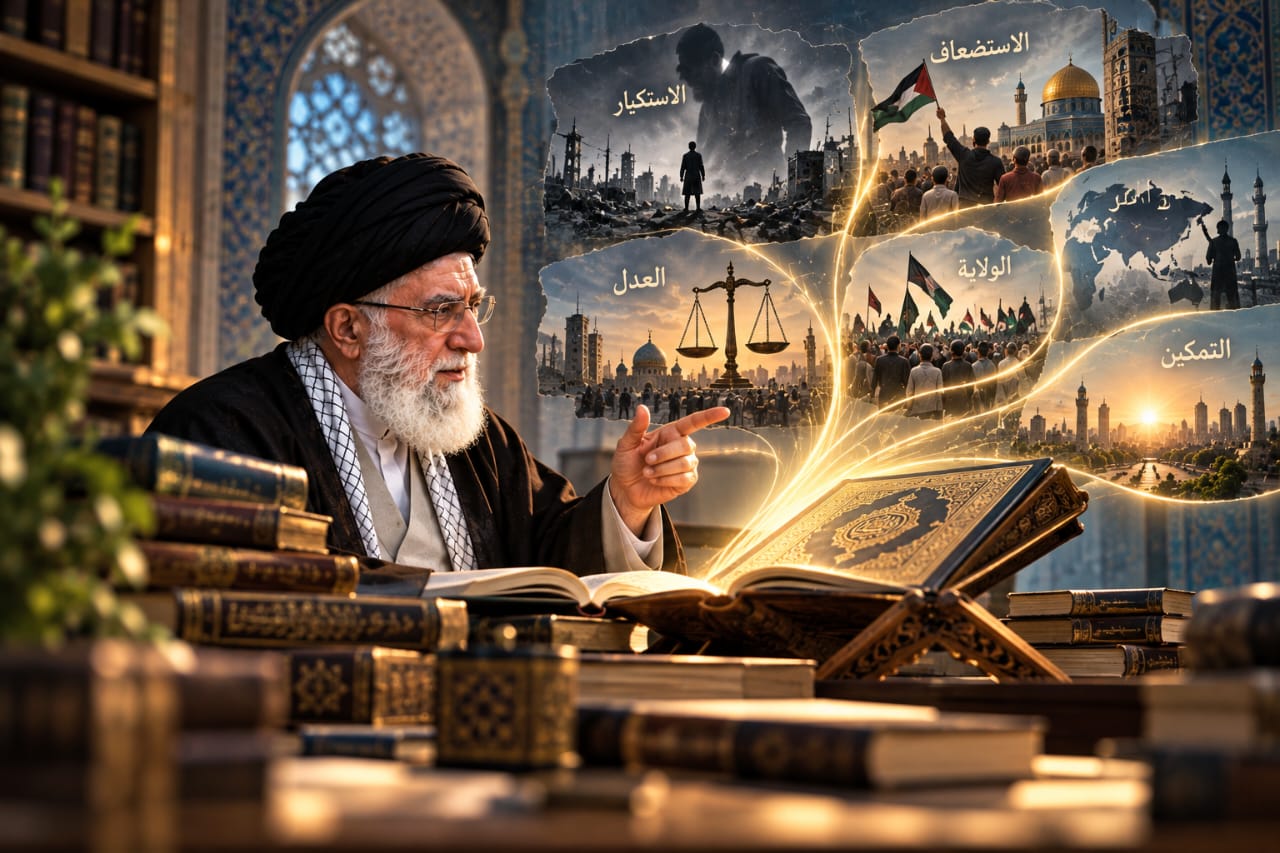
Political Interpretation of Quranic Concepts: Study of Ayatollah Khamenei's Exegetical Perspective Centered on the Islamic Revolution - Ali Reda Daneshyar

Share this post :

This study examines the political interpretation of Quranic concepts from the perspective of Sayyid Khamenei (QS) during the Islamic Revolution. It aims to examine Sayyid Khamenei's (QS) approach to the political interpretation of the Holy Quran and to explore its impact on the trajectory of the Islamic Revolution.

The research method followed in this study is the descriptive-analytical method, and the framework is the influence of political, social and intellectual fields on the emergence of political interpretation of Qur'anic concepts and their role in the progress of the Islamic revolutionary movement and its specific uses. Before the Islamic Revolution, Sayyid Khamenei (QS) benefited from the Holy Qur'an in the political interpretation of doctrinal concepts such as monotheism, prophecy, and imamate in the midst of the jihadist movement, struggle, and revolution against the situation controlling at that time of internal tyranny, external dependence, and hegemony. After the revolution, his political interpretations focused on the structure of the political system, the struggle against hegemony, and the call for brotherhood and Muslim unity.

Comments


Related topics

Oumam magazine, for Human and Social studies, is a peer-reviewed quarterly scientific periodical, issued by "Baratha Center in Beirut and Bagdad. It is concerned with criticizing Western visions of humanity and society in various fields . on the other hand, rooting them from a rational standpoint, that is consistent with the requirements of human nature, and with the original metaphysical cosmic vision of human society.The magazine aims to confront the Western intellectual challenges imposed by the West on our Arab and Islamic societies, through:
messages.copyright © 2023, Oumam for Humanities and Social Studies