
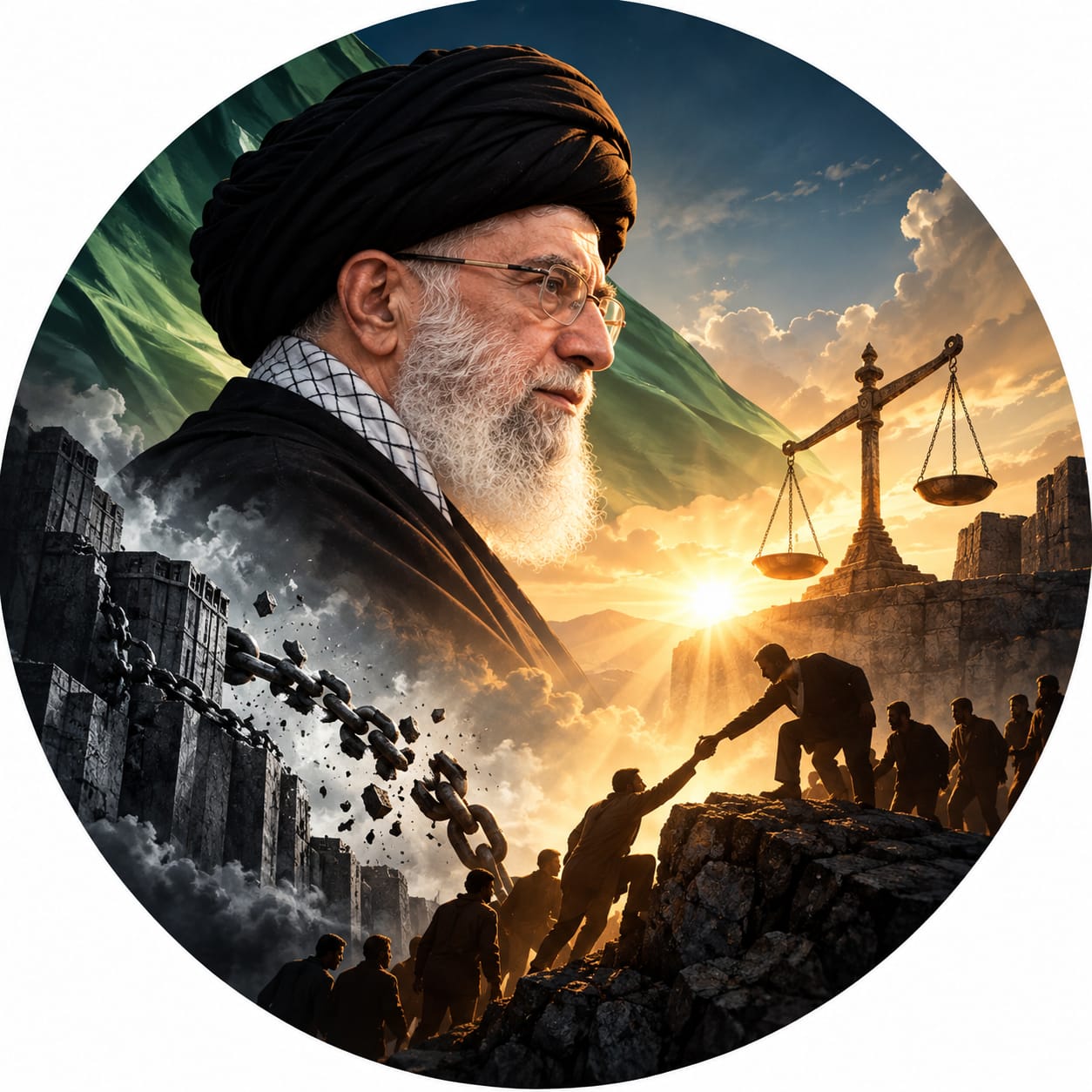

This has imbued the concept with a political and economic character, leaving unresolved questions regarding the spirit, purpose, and destiny of revolution: Why do revolutions age and wither? What connects them to the human essence, to human meaning, values, and destiny? A purely materialist concept cannot answer these questions. The revolution manifests in various forms within the human experience: political revolutions that topple one regime and establish another; social revolutions that transform the structure of society; and intellectual revolutions that alter humanity's perception of itself and the world. Yet, the common thread linking these forms remains elusive. What truly defines a movement as a revolution, and what distinguishes it from mere fleeting unrest or a simple transfer of power? This is an age-old question, the answers to which have been shaped by entire schools of thought within modern political theory.
Many of these schools have viewed revolution through a singular lens, reducing it to a shift in the balance of power or a materialist inevitability governing the course of history. In doing so, they have displaced the human being from the centre of the revolution and overlooked its spiritual, axiological, and ethical dimensions. Hence, there arises a need for a theoretical framework that restores the human being to the heart of the revolution, links it to human purpose and meaning, and addresses what the prevailing concept fails to explain: What is the true nature of revolution, and in what direction is it headed?
Understanding revolution requires a philosophical perspective that precedes the event itself, interrogating the concept prior to the facts. It demands an inquiry into the revolution's essence, foundations, logic, and objectives, while situating it within a comprehensive vision of humanity and history. Within this context, the theoretical perspective of Imam Khamenei holds a distinctive position; he interprets revolution as a profound transformation of the human being and of values, anchoring it in roots that run deeper than politics to transform it into a universal human discourse rather than a mere local event.
These pages open up a new horizon for interpreting revolution as a philosophy; they begin by addressing revolution as a universal human concept, as it has crystallized in modern thought and experience, before moving toward a theoretical framework that elevates it from a local event to a universal philosophy addressing humanity everywhere. The text follows a progressive structure, starting with the nature and foundations of revolution, moving through the logic of its life and continuity, and culminating in its ultimate purpose and humanitarian mission, as well as its roots in the event of Karbala and their application in contemporary experience. This analysis aims to raise and organize key issues while preparing the mind for further elaboration, for asking the right question is half the journey toward finding the right answer.
First: Revolution as Human Concept, From Experience to Modern Theorization
At its core, the word "revolution" carries the meaning of rotation and return, a concept borrowed by ancient astronomy to describe the movement of celestial bodies in their orbits. With the advent of the modern era, the term's meaning shifted to signify radical change and the onset of a new phase in social life; the prevailing conception came to view its essence as a “Ibtida” [beginning], the establishment of a new order of freedom. The revolution is an event that breaks with the past and inaugurates a distinct political era. The French Revolution stands as the quintessential example, representing a profound rupture that reshaped both state and society, simultaneously embodying the promise of liberty and the fear of regression.
Linked to this concept is the question of boundaries: a coup is a change at the helm of power that leaves the underlying structure intact; reform is a gradual adjustment within the existing system; rebellion is an act of defiance that may lack a vision; whereas a revolution entails a project to transform both structure and values. Thus, revolution transcends the confines of a mere political event, offering a vision that links the transformation of power to the transformation of the human being. In contrast to this conception, a materialist understanding emerged that views revolution as the product of a struggle between social forces and the transformation of the economic structure. It interprets history as a succession of modes of production, with revolution serving as an explosive moment in which a rising class supersedes a declining one, thereby positioning the economic factor as the fundamental driving force and regarding values as a reflection thereof.
A third school of thought viewed the revolution much as a physician examines a body, tracing its "anatomy" and stages: the initial fever, the rise of hardliners, and the phases of moderation and reaction. It observed that many revolutions betray their own principles or revert to a new form of tyranny. This perspective revealed that revolutions have a lifespan, a birth and a death, yet it left the deepest question concerning them unanswered.
These perspectives interpret the revolution through the lenses of power, economics, and violence, illuminating its foundational political dimension, its social roots, and its historical phases, yet they relegate the human being to the margins, treating the individual merely as an instrument in power struggles or a product of structural dynamics. Such reductionism fails to capture the spirit of the revolution and its ultimate purpose: the kind of human being it seeks to shape and the world it aims to build. A revolution devoid of an objective that transcends the mere overthrow of the status quo moves in a vicious circle, merely replacing one oppressor with another. Hence the need for a conceptual framework that restores the human being to the heart of the revolution, linking it to human meaning, values, and destiny, and elevating it from a local event to a universal human significance, an approach found in the thought of Imam Khamenei (QS).
Secondly: Revolution According to Imam Khamenei: Concept, Foundations
Imam Khamenei's (QS) conception of the Revolution begins with its essential meaning rather than the event itself. To him, the Revolution is a "comprehensive transformation within a human collective", not merely the events that marked its inception, for those constitute only a small fraction of the whole. It is a profound shift in thought, action, and values that spans the life of the nation, transforming the Revolution into an enduring reality rather than an event confined to a specific moment in time. In this way, his conception diverges fundamentally from a materialist perspective; its roots are human and spiritual, not material. Khamenei (QS) links the Revolution to a root far deeper than politics: the movement of the prophets. When a Messenger is sent, he sparks a revolution and initiates a revolutionary movement within society, one that encompasses thought, action, and values; this constitutes the very essence of the religious movement and its revolution. In his view, the revolution of the prophets entails transforming people's minds and their perspective on existence, prior to any change in the system of governance, and he posits that the contemporary revolution represents a renewal of the essence of the Prophetic mission and a manifestation of its path in the modern age. Through this connection, revolution becomes a continuous thread in human history, wherein its forms are renewed while its spirit endures.
For him, the revolution rests on foundations that render it a universal human reality. The first of these is its harmony with innate human nature [fitra]; its goals align with the innate disposition of the masses, allowing it to be embraced by hearts, as its proponent speaks the language of that innate nature, resonating along with the innate inclination toward truth and justice that Allah, Almighty, has instilled in the human being. The revolution speaks the language of innate human nature, addressing the human being at their shared core and thus transcending the boundaries of nation and language.
The second element is the system of values. For him, the revolution is a blend of calls for justice, freedom, independence, and popular sovereignty, with spirituality and morality as its ultimate goals; it rests on solid foundations unrelated to either Eastern socialism or Western liberalism. He views it as a "novel proposal, a modern word and idea for human life", standing in contrast to a world held captive by major powers; it offers humanity an alternative conception of life's meaning, emerging as an independent civilizational discourse that transcends the divide between the two materialist blocs.
The third aspect is the divine dimension. For him, the revolution was a "revolution for the sake of Allah," and it was conducted in this very spirit; that is why it endured, persisted, and attained steadfastness and moral strength. Its divine root grants it permanence and meaning, connects it to an end that transcends immediate gain, and affirms that it rests upon "theoretical foundations" requiring deep understanding; for whoever enters its arena driven merely by zeal, lacking a solid theoretical basis, will be swept away by the storm and lose their way. It is, after all, an idea before it is a movement.
These principles converge on a single goal: forging a free, dignified human being who transcends the material realm to become a servant of Allah alone, for revolution is a movement within the soul before it is a movement in society. Because innate human nature is shared, values are unifying, and the divine dimension connects the human being to their origin, the revolution acquired a universal scope, a message reaching everyone who seeks justice and abhors injustice, and upon this concept, the logic of the revolution's unfolding is built.
Third: The Logic of Revolution, Life, Continuity, and Waning.
Imam Khamenei (QS) views the revolution as a living entity, possessing a birth, growth, and constitution, as well as potential ailments and an eventual end. This metaphor shifts the perspective from a static event to an evolving phenomenon; the revolution thus acquires a lifespan, developmental stages, and states of health and illness, governed by the logic of life rather than that of a fleeting incident. The revolution is an "ongoing reality" rather than a one-time event; profound transformation is not achieved in a year or five, and the process of becoming knows no bounds. A revolution that believes itself to be over loses its meaning, for its essence lies in perpetual motion; continuity is an intrinsic quality, not an incidental one.
He distinguishes between the constant and the variable within it: supreme ideals and major goals remain fixed, while means and methods are renewable, shifting with changing circumstances. It exists in a state of constant renewal and transformation, preserving its foundational principles while updating its tools. It is a "gradual transformation", not a sudden, singular event, requiring time to solidify its pillars. Recognizing this gradual nature guards against the haste to see results and the tendency to deem the revolution a failure at the first sign of an obstacle.
He also addresses the phenomenon of revolutionary decline, citing the French Revolution and the October Revolution as examples: two major revolutions that failed to remain vital, ultimately transforming into harsh dictatorships or reverting to pre-revolutionary conditions. A revolution dies when it severs ties with its principles or stagnates, losing its vitality; recognizing this death is essential to preserving its life. Its preservation lies in adhering to fundamentals while rejecting stagnation, advocating a "foundationalism" free from rigidity or dogmatism, and rejecting innovations or calls for revisionism made under the guise of 'ijtihad' (independent legal reasoning). A revolution exists between two perils: stagnation that stifles its momentum and unbridled license that dissolves its identity; indeed, "inertia, stillness, and silence breed stagnation." It is described as a "living phenomenon possessed of will", "flexible and ready to correct its own errors", demonstrating a constructive receptiveness to criticism while remaining steadfast in its values. Thus, a general logic governing the course of the revolution becomes evident. It is a living entity that upholds its principles, while renewing its methods; faces extinction only when it succumbs to stagnation or its roots are severed, ensuring that these principles remain the framework defining its ultimate goal.
Fourth: Revolution's, Its Universal Humanitarian Call
The question regarding the revolution's ultimate aim remains: Where is it heading, and what kind of world does it seek to build?
For Imam Khamenei (QS), the revolution has a purpose that transcends the mere overthrow of the incumbent regime; it aims to establish justice and uphold human dignity. A revolution devoid of a lofty goal merely moves in a vicious circle, whereas one driven by a humanitarian purpose resonates with every human being.
He encapsulates its logic in a single call: "Do not oppress, and do not be oppressed." Its call is defined as "confronting the system of hegemony and domination", a system that divides the world into oppressor and oppressed. This call resonates across humanity; after all, who would refuse to neither oppress nor be oppressed? It is a call that appeals to the innate human rejection of injustice, thereby transcending national borders and linguistic barriers. Its discourse "calls for justice and freedom for humanity" and advocates dismantling the system of hegemony, ensuring that no dominant force remains to subjugate another. It is described as a "major human awakening", a "cry for justice and a call for human dignity in a world rife with injustice." The message here is one of universal humanity; it pits the revolution against global injustice and reaffirms the human being as an end in itself, rather than a mere instrument.
It moves toward defending the oppressed and the deprived, for the message of Islam is fundamentally a "message of defending the oppressed", aligning itself with the downtrodden wherever they may be, rather than with a narrow nationalist agenda. Its objective extends beyond merely lifting injustice to a civilizational undertaking that bridges power with values and progress with meaning; it serves as a foundation for construction, not a destructive force that halts once the existing order is toppled. It is viewed as a prelude to a broader movement: the revolutions that erupted in Islamic countries against puppet dictatorships serve as a precursor to the "revolution against global dictatorship" and the network of arrogance, expanding from the local level to a confrontation with the international system of hegemony. Its universality is one of ideas and appeals, not of imposition or coercion; it spreads through the power of its meaning by addressing the innate nature of the human being. Thus, the revolution transcends a mere historical event to become a universal message reaching all who seek justice, its contours fully defined by its concepts, foundations, logic, and purpose. It remains for us to witness its implementation, where its Karbalai origins converge with contemporary experience.
Fifth: Karbala is Foundation, the Islamic Revolution is the Implementation.
For Imam Khamenei (QS), the philosophy of the revolution finds its completion when connected to its primordial essence: Karbala. In his view, Ashura is the "Day of the Husseini Revolution," and the subsequent movements led by Lady Zaynab (peace be upon her) and Imam al-Sajjad (peace be upon him) are merely extensions of it. He regards Karbala as the consummate model of revolution; it embodies the principles, conceptual, structural, logical, and teleological, that serve as the benchmark against which all subsequent revolutions are measured.
He maintains that the revolution of al-Hussein (peace be upon him) was undertaken to "fulfil a momentous duty": namely, "restoring Islam and Islamic society to their true path and revolting against deviations... regardless of the outcome." In this context, the concept manifests as a transformative stance and a confrontation with deviation, while the logic manifests as the fulfilment of religious duty, independent of calculations regarding military victory or defeat. He further emphasizes that understanding al-Hussein (peace be upon him) requires recognizing his "acts of clarification and his enjoining of good and forbidding of evil," noting that the Battle of Ashura was but one facet of his struggle; the Husseini Revolution was, first and foremost, a project of clarification and enlightenment, rather than merely a military conflict.
Karbala represents an ongoing revolution that has made the followers of Ahl al-Bayt (peace be upon them) standard-bearers in the struggle against injustice throughout history. From this foundation stems the concept of a perpetual revolution and an unceasing conflict between truth and falsehood, crystallizing in the slogan "Every day is Ashura, and every land is Karbala", an expression of the enduring nature of this confrontation across all times and places.
It is from this foundation that he interprets the contemporary experience, invoking its founder, Imam Khomeini, whom he regards as having brought about a "renewal of the essence of the Prophetic Mission" and as the one whom Allah enabled to revive the "enduring path of the Mission" after it had waned. He explicitly links his revolution to Karbala, viewing the events of Imam al-Hussein's (peace be upen him) era as having a microcosm in the age of Imam Khomeini, who revived the path of the prophets and the way of al-Hussein in the modern era.
The revolution erupted amidst the atmosphere of the month of Muharram and from the mourning gatherings for Imam al-Hussein, (peace be upon him). Khamenei (may his soul be sanctified) traces the spark of the revolution to the series of "Arbaeen" commemorations, beginning with the blood shed in Qom and extending to the subsequent Arbaeen observances that mobilized the masses in public squares right up to the day of victory. Religious scholars stood at the forefront of this movement, disseminating revolutionary consciousness from the pulpit; no sooner was a slogan raised in Tehran on the day of Ashura than its echo would instantly resound in the smallest of villages, uniting religion and politics upon the path of Karbala.
He views this experience as a "model of the great event of Ashura", one that found its manifestation during the era of the Sacred Defence, and perceives its "continuity and blessings," regarding the Arbaeen pilgrimage as an "extension of the Revolution." This foundational principle elevates the Revolution beyond the confines of sect and nationality; the logic of Karbala, rooted in the rejection of injustice and the championing of truth, serves as a universal language. Furthermore, he sees the great Arbaeen procession, drawing people from dozens of countries, as an embodiment of Islamic civilization and a means of strengthening bonds between peoples. Thus, the cycle is complete: Karbala stands as the origin and model, and Imam Khomeini (QS) as the one who put its principles into practice, ensuring that Karbala remains the standard by which the Revolution is measured.
These pages converge on a single idea: that the thought of Imam Khamenei (QS) offers a conceptualization of revolution that rises to the level of a universal philosophy. Starting from the concept of revolution as a universal human phenomenon, as articulated in modern thought, we find the materialist perspective inadequate to capture its true essence. We then move to a distinct conceptualization: revolution as a comprehensive transformation rather than a mere seizure of power. Its roots lie in the revolutions of the prophets, and its foundation rests upon innate human nature (fitra), values, and the divine dimension.
Thus, the logic governing its life, continuity, and decline becomes apparent, as do its purpose, its humanitarian call, and its Karbala-rooted origins, manifested here in the contemporary experience.
This perspective presents a philosophy of revolution that transcends the confines of a local event, reaching the realm of universal human significance. At its core, revolution is a movement within human consciousness, prior to being a shift in the balance of power, and its call, "Do not wrong others, nor be wronged", appeals to innate, sound human nature. Thus, the revolution transforms into a universal message that defies the constraints of time and space, addressing all who seek justice and reject oppression.
In this conceptual framework, Karbala remains the fundamental source and the standard of measure; from it, Imam Khamenei derives the meaning, logic, and ultimate purpose of the revolution and by it, he gauges its authenticity and enduring nature. As for the contemporary experience, embodied by its founder, Imam Khomeini (QS), it stands as a living application of this principle, rather than merely a subject for theoretical discourse. It is this link to Karbala that connects theory to reality, demonstrating that his philosophy of the revolution is a viable, living philosophy.
These landmarks raise fundamental questions: What are the limits of revolution as a concept? What are the conditions for its continuity and the causes of its decline? How do human ideals intersect with historical implementation? What is the place of Karbala in formulating a general theory of revolution? The studies in this issue explore these questions, raised by the theorizing of Khamenei (QS), each from its own perspective.
What we have presented here serves as a prelude to and an arrangement of these issues, a harbinger of the detailed content within this issue, as the studies coalesce into a cohesive thematic unity, grounded in the conviction that framing the right question is half the journey toward finding the right answer.
This vision derives its significance from its position at the intersection of the modern concept of revolution and its religious roots; it poses the question of the human experience regarding revolution and answers it by returning the human being to the revolution's essence and restoring meaning to its trajectory. While modern thought has reduced revolution to a mere matter of power dynamics, Khamenei (QS) restores it to its spiritual and ethical dimensions, linking it to a purpose that transcends immediate gains. In doing so, he offers an intellectual contribution that transcends the dichotomy of the two materialist camps.
This conceptual framework simultaneously embodies both authenticity and universality: its authenticity stems from its Karbala-based roots, which lend it historical depth, while its universality lies in its humanitarian appeal, addressing the downtrodden everywhere. Thus, particularity opens onto a broader horizon; the logic of Karbala, centered on championing the oppressed and opposing injustice, represents a shared human value. It is from this synthesis of root and horizon that his philosophy of revolution derives its strength and its capacity to resonate with people across all times and places.
Ultimately, the philosophy of the revolution as articulated by Imam Khamenei (QS) represents a fertile field worthy of serious attention. Its substance is scattered throughout his speeches, lessons, and addresses, awaiting someone to gather, organize, and ground it in a systematic framework. This issue marks a step along that path; it opens the door, lays the foundational stone, and invites researchers to further explore a revolutionary philosophy that bridges the foundational legacy of Karbala with a universal human horizon.
In any case, the research papers in this issue are presented as follows:
The section "Focus" contains:
-The paper titled "Concept of Revolution According to the Martyr-Imam Khamenei," by Dr. Ahmad Majed (Lebanon).
-A second paper by Prof. Rahman Abdul-Hussein Daher (Iraq) titled "Value-Based, Ethical Aspect of Revolution in Imam Khamenei Thought."
-Dr. Ali Al-Mohammadawi (Iraq) writes: "Political Theory of Revolution in Imam Khamenei (QS) Thought."
-The fourth paper, by Mohammad Ali Barda (Lebanon), discusses "Role of Clarification (al-Tabyin) in Perpetuation of Revolution."
-The final paper in this section, authored by Dr. Talal Atrissi (Lebanon), titled: "Philosophy of 'Civilizational Independence' within Intellectual Framework of Sayyid Khamenei: from Political Liberation to Cognitive Emancipation."
In the "Foundations" section, a paper in Persian by researcher Ali Reda Daneshyar (Iran) was selected, titled "Political Interpretation of Quranic Concepts: Study of Ayatollah Khamenei's Exegetical Perspective Centered on the Islamic Revolution," translated by Dr. Mohammad Firas Al-Halbawi (Syria).
Finally, in the "Studies and Research" section, Dr. Abdullah Badawi (Lebanon) presents a paper titled "Economic, Cultural Jihad: Analytical Study of Sayyid Mojtaba Ali Khamenei's Vision in Light of 'Jihad of Construction' and 'Resistance Economy' Experiences."
May Allah have mercy on our martyr-leader Khamenei and all the martyrs, who fell while confronting the tyrants of the Earth.
Sources and References
1. Ali al-Hosseini al-Khamenei: "Exegesis of Surah Al-Mujadila."
2. Ali al-Hosseini al-Khamenei: (Speech of the Guardian's – Collection of Annual Speeches), Al-Maaref Center for Authorship and Research, Beirut; years: 2009, 2010, 2012, 2013, 2015, 2016, 2017, 2018, and 2019.
3. Ali al-Hosseini al-Khamenei: "The Leader's Call".
4. Hannah Arendt, "On Revolution," translated by Ata Abdul-Wahab, reviewed by Ramez Bursalan, Arab Organization for Translation, 1st ed., Beirut, 2008.
5. Karl Marx and Friedrich Engels: "The Communist Manifesto."
6. Crane Brinton: "The Anatomy of Revolution", translated by Samir al-Chalabi, reviewed by Ghazi Barou, Dar Al-Farabi, 1st ed., Beirut, 2009.
7. Ali al-Hosseini al-Khamenei: Televised Speech to Ministry of Education officials, September 1, 2020.
8. Ali al-Hosseini al-Khamenei: Speech on the Prophet's "Mab'ath," March 11, 2021.
9. Ali al-Hosseini al-Khamenei: Speech at a meeting with commanders and officers of the Air Force and Air Defense Forces, February 8, 2023.
10. Ali al-Hosseini al-Khamenei: Speech at the commemoration ceremony of the martyrdom of Imam al-Rida (PBUH), August 25, 2025.
Praise be to Allah, Lord of the Worlds.


Comments