
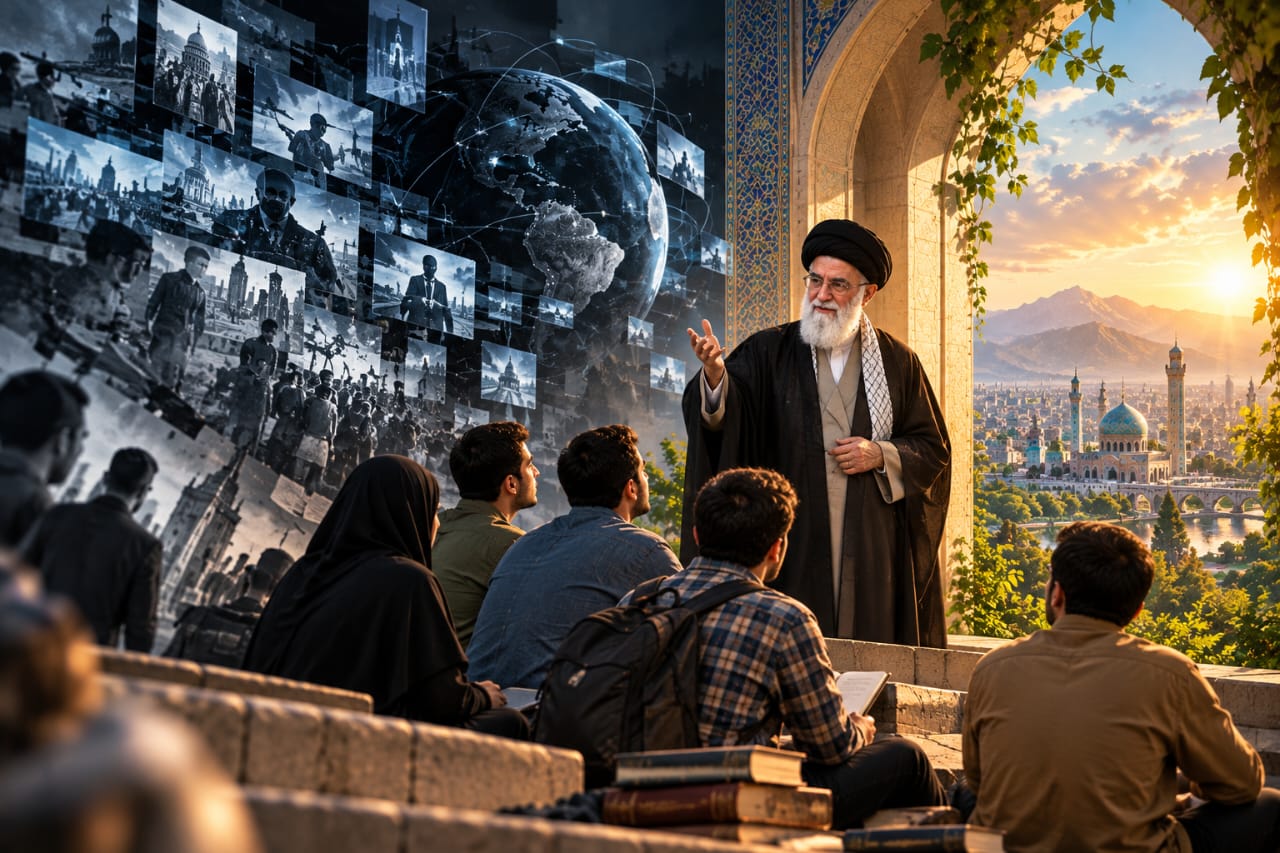
Philosophy of 'Civilizational Independence' within Intellectual Framework of Sayyid Khamenei (QS) from Political Liberation to Cognitive Emancipation - Dr. Talal Atrissi

Share this post :

The research addresses the issue of independence as a central idea for Sayyid Khamenei (QS) in his leadership experience of the Islamic Republic, and in his theoretical vision of Islamic civilization.

 This vision is based on the universal reference of the Qur'an, the basis of which is monotheism. Therefore, the goal of Islamic civilization will be to build man and meet his material, moral, and spiritual needs at the same time.

Sayyid Khamenei (QS) aspires to achieve civilizational independence, first and foremost through the production of culture, as well as through the entrenchment of scientific and intellectual values, university curricula, the dissemination of ethical and humanitarian values, the economy, the development of defence capabilities, and political values; in short, by avoiding dependency in all spheres of life.

From this perspective of civilizational independence, Sayyid Khamenei (QS) simultaneously emphasizes unity with other Muslim peoples and states in order to achieve political liberation and intellectual emancipation.


Comments


Related topics

الخميس 15 تشرين الاول 2026
Oumam magazine, for Human and Social studies, is a peer-reviewed quarterly scientific periodical, issued by "Baratha Center in Beirut and Bagdad. It is concerned with criticizing Western visions of humanity and society in various fields . on the other hand, rooting them from a rational standpoint, that is consistent with the requirements of human nature, and with the original metaphysical cosmic vision of human society.The magazine aims to confront the Western intellectual challenges imposed by the West on our Arab and Islamic societies, through:
messages.copyright © 2023, Oumam for Humanities and Social Studies