
These are questions about God, humanity, and the universe; questions asked by the Greeks, then by the Muslims, and later by the Europeans. Today, however, humanity faces a different rather question, one that is sharper and more urgent. This question no longer concerns the external world or what serves humanity; it is about the human being himself, about what was once believed to be exclusively his: his mind, his thinking, and his ability to create, understand, and interpret.
The artificial intelligence did not emerge overnight. Its foundations have been built over decades, drawing from the intersections of mathematics, logic, neuroscience, philosophy, and computer science, gradually reaching a threshold in recent years that redefines what is possible. Yet, what distinguishes the current moment is not merely the accumulation of technological potential, but the fact that this accumulation has reached a point where existential questions demand answers that cannot be postponed: What is a human being? What defines us? And where is the dividing line between us and what we have created with our own hands?
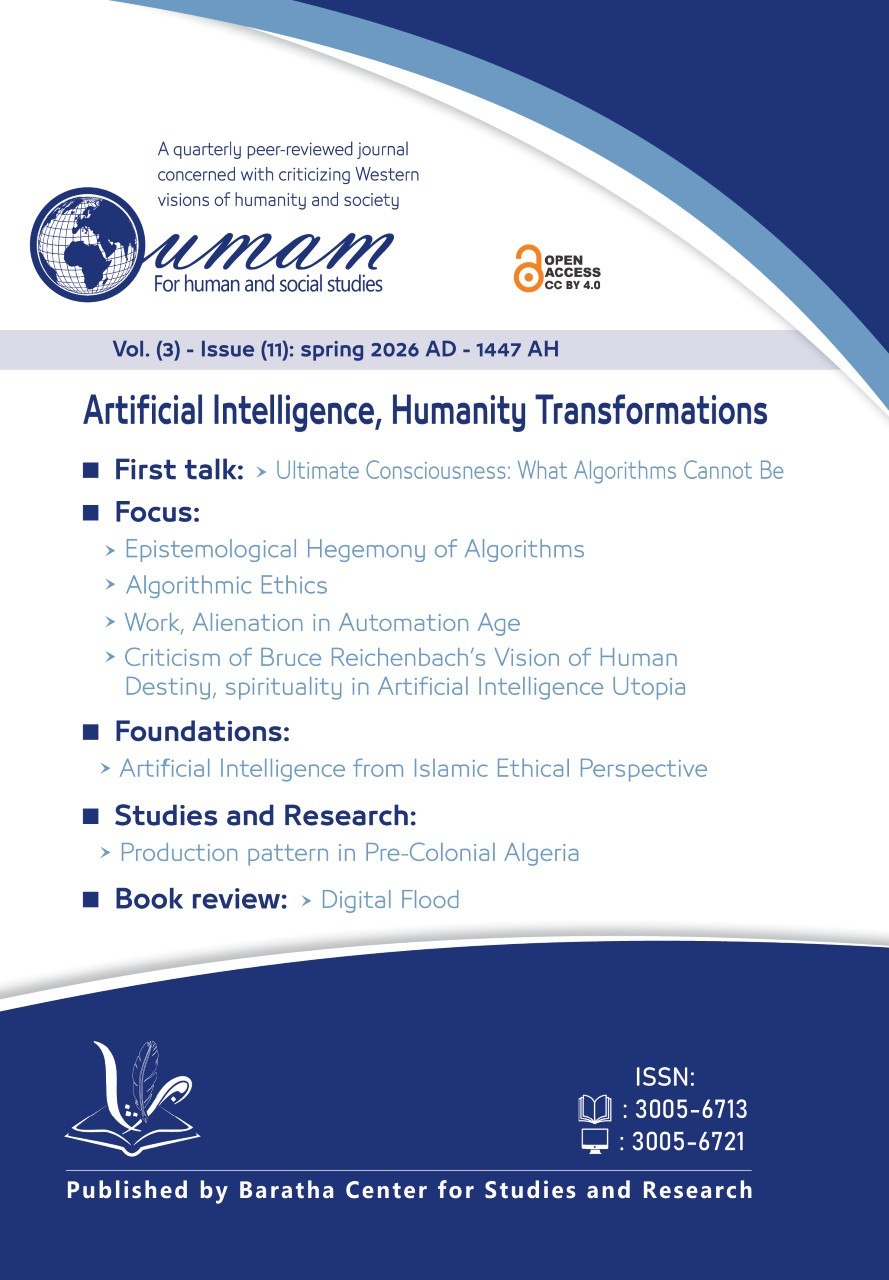
...The research discusses the dominance of Western development environment algorithms in producing globalized knowledge that reflects Western values and standards, which may lead to the marginalization or distortion of other knowledge systems. It also analyzes the mechanisms through which algorithms reproduce historical and cultural power relations, revealing the phenomenon of digital epistemological colonialism. In conclusion, the research provides a critical reading of the claim of technology neutrality, proposing an alternative cognitive framework based on pluralism and cognitive justice in the design and application of artificial intelligence systems.
...It begins with a philosophical perspective that views work as a cornerstone of self-realization, then explores the concept of "alienation" as a state of separation from work and society. With the acceleration of digital transformation, alienation has taken on a new dimension dominated by algorithms and data, where workers are subjected to monitoring and evaluation within opaque systems. It also discusses the impact of automation on the labor market through job fragmentation and the replacement of routine tasks, which exacerbates the polarization between high-skilled and low-skilled jobs and leads to the erosion of the middle class. It highlights the role of the platform economy in deepening job insecurity and placing the burden of risk on individuals, while simultaneously pointing to the rise of tech elite that widens the digital divide.
The research also addresses ethical issues such as privacy
concerns and algorithmic bias, emphasizing that guiding technology
towards equitable paths depends on public policies and social choices.
It concludes that the future of work is determined not only by technical data, but also by political and ethical choices, and that preserving human dignity requires ...
However, Bruce Reichenbach argues that realizing this utopia faces theological and philosophical challenges.
This article aims to explore and assess these challenges in light of Mulla Sadra's wisdom and the views of AI specialists on issues of human identity, spirituality, worship, free will, and ethical decision-making. While Reichenbach's concerns are significant, they appear problematic when viewed from a specialist perspective, as they overlook issues such as the survival of prototypes, the possibility of simulating emotions in religious experiences, the assumption of a deity as the object of religious experience, and the feasibility of realizing models of free will and developing moral consciousness in powerful artificial intelligence.
The research begins with the premise that addressing current problems requires more than just partial rulings or technical solutions; it necessitates invoking a comprehensive ethical system to provide a governing framework for dealing with these issues.
It employs a three-tiered analytical methodology: first, establishing a central value framework based on the established principles of the Qur'an and Sunnah; second, formulating operational ethical values; and finally, applying this system to the most prominent contemporary challenges.
The research seeks to offer an alternative ethical model capable of re-evaluating the principles underlying the dominant Western model, while proposing practical pathways derived from higher Islamic values to support digital governance policies that align with our religious and cultural identity.
It also presents piracy as a mode of production, demonstrating that the acquisition of maritime plunder was an extension of the plunder economy that dominated the Maghreb during the medieval period and was linked to the tribal structure, which forms the cornerstone of Ibn Khaldun's theory of the formation of the Maghreb state. Furthermore, it clarifies that modern Algerian identity crystallized within the context of piracy as a mode of production, emphasizing that this trajectory was not unique to Algeria.
The material development of several major European states and empires, and even the Industrial Revolution in England, occurred within the same framework. In this same context, the study seeks to purify the history of piracy in Algeria from the remnants of colonial narratives and offers an answer to the problem of the contrasting outcomes of this mode of production, which failed in Algeria but succeeded in Europe.
It has become possible to record, store, and broadcast everything humans do globally in moments, coinciding with the ability of supercomputers to analyze this massive amount of data and extract patterns. What was once pure fantasy has now become a reality, posing fundamental challenges and questions about how these technologies are utilized and their impact on governments, individuals, and future generations.
From this perspective, this book, drawing on decades of experience in the field of computing, offers a comprehensive yet accessible vision to help the reader understand the dimensions of the digital explosion and its legal, cultural, and social implications. It also encourages active participation in the ongoing dialogue surrounding these issues, which are of concern to all societies striving for freedom.
The book explores how this digital explosion has transformed the details of our lives into traceable and analyzable data, opening up vast horizons for information sharing and communication, while simultaneously presenting significant challenges related to privacy, security, and individual responsibility.



Comments