
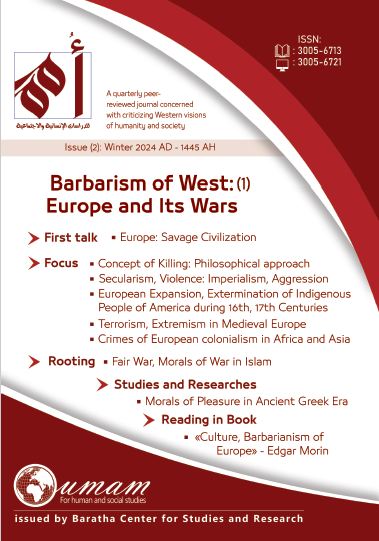
Although the history of different nations recorded an extensive record of wars, it did not place the countries that caused the wars on a single scale, especially if we look at it through the size of the population ratios and the privileges available to them. The Western European model and what emerged from it by its title stand out as a striking model in human history, especially since its vitality in the issue of making wars continues to characterize its civilization until today.
European history is characterized by having the most wars and bloodshed, regardless of what happened in its history or what it does in its contemporary reality, and its global record rates maintain the highest rates, without competition from anyone from any other civilizational group. Despite the multiple factors that are usually involved in making wars, the West is distinguished by the fact that its religious reality in the Middle Ages does not differ in this quality from its secular and atheistic reality in later eras, all the way to the reality we live in today.
Wars and killing are ...
firstly because the act of killing was strongly linked to the political and philosophical transformations witnessed in the modern stage, through which the concepts of the state and sovereignty were rebuilt. Secondly, and this is specific to post-modern philosophy, because the act of killing is criticized for causing actions that go beyond the modern conception of killing in life, such as issues related to mutilation, disability, and death. This is what made philosophers confront it with analysis and criticism, especially since it came accompanied by violence after the entire world had settled that contemporary life was dominated by peace and security. But it turns out that the idea of security that the state - as the holder of power - seeks to ensure, at the same time conceals a killing different from that which existed before. If killing was previously in exchange for life, that is, to defend life, then life itself in the contemporary understanding, as Michel Foucault shows, is what drives death.
To achieve what we were aiming for, we asked the following questions: What is killing and what ...
in which religion was replaced by non-religious entities, and rogue secularism, which seeks to renege the religion), de-sanctification, and violence as a violation of the sanctities of mankind and nature, aggression, injustice, and ignorance. This desecration does not occur until the human being is de-sanctified and transformed into a material for use. Here, comprehensive secularism emerges as a de-sanctification, which makes it identical with violence - the essential component in the nature of secularism itself. This appears mainly in its manifestation through imperialism, the Italian wars, post-modernism, the new global consumer colonialism led by the United States of America, and global Zionism. The article sought to clarify this through two major stages: replacement secularism and rogue secularism.
...within a careful reading of historical events with the aim of justifying the conquered peoples and revealing and revealing the circumstances associated with the European expansion (Portuguese, Spanish, English, and French) in South America and North America during the 16th and 17th centuries AD, and clarifying the forms of violence and crimes committed and the ugliness of what they committed, which is considered an organized and systematic crime against humanity, despite the attempts of many colonial circles to erase and deny it, and to refute the circulating ideas that what happened is a natural event during wartime and does not rise to the level of genocide, but rather it is just self-defense. This study sought to prove the bloody and racist practices that led to the annihilation of people and places, it was not just an annihilation but several annihilations: the annihilation of indigenous races, the desecration of the land, the destruction of the population, the marginalization of the cultural and civilizational heritage and erasure it from local and human memory.
...and the alienation of human values due to the brutal massacres and genocide that Gaza is being exposed to, and the Zionists carrying out horrific war crimes. If we want to know the criminal doctrine of the Zionists and its formation, we must know their political environment from which they came in the European diaspora. This helps us understand the Western and American role in supporting terrorism and extremism.
This study will shed light on extremism and terrorism in Europe during the Middle Ages, by adopting the objective historical approach, presenting and analyzing scenes of historical events that occurred in the Central European era, and clarifying the roots of terrorism, extremism and the rejection of the other in that era.
Here, we raise the problem of how religious wars shaped the history of Central Europe and left their bloody terrorist mark on human history to this day? Then we ask the question: Were these bloody historical milestones real for projects of enlightenment, patriotism, and world peace, or were they an episode of global terrorism and extremism that we witness today?
...and pointed out the determinants of colonial discourse, by relying on the descriptive historical approach that most appropriate to the topic. We chose four examples of colonial crimes in Africa, but we limited ourselves to mention the most brutal of them, which are the crimes of genocide in Algeria during the 19th and 20th centuries, "Diabe" and "Makondi" massacres in Ivory Coast, then the crimes of Belgian colonialism in the Congo, and the conclusion was the crimes of German colonialism in Namibia. While we chose the crimes of British colonialism in India, and the crimes of French colonialism in Indochina, as examples of crimes carried out in Asia.
The content of this research requires more documentation effort - to enumerate all the crimes of colonialism in the rest of the world continents starting from the 16th century AD - and analyzing the colonial discourse by delving more deeply into its structure.
...in the period before European colonialism, by presenting the most important peoples who were able to reach the continent before the Europeans knew about it, and the civilizations that arose and flourished before the continent was exposed to European invasion, the most important of them are: Aztec, Inca, and Mayan civilizations. The research contains a brief description of this continent and the progress it has achieved. It also addresses the first European invasions of the continent, in particular the four voyages of Columbus, the voyage of Amerigo Vespucci and the traveler Alvarez, and the discoveries that occurred. Then, we discussed the European expansion into the continent, the systematic destruction of the ancient civilizations that had existed until that time, the plundering of the continent’s resources, killing its inhabitants and the replacement of them with the African ones.
The research concluded the most important negative consequences of European colonialism of the continent and the plundering of resources, depopulation, and change in the nature of American societies there.
...The purpose of the research is to show the brutal European model for what it is exactly, through showing practices on civilians and military personnel, and presenting the extent of hatred among Europeans, which led to the destruction of infrastructure of all kinds. To deal with the issues and ideas that were raised, we also relied on the descriptive and analytical approach, reaching results that showed images of European brutality of all kinds and methods in the two world wars, perhaps the most notable of which was the fall of a large number of innocent people, due to using internationally banned gases, genocides, plundering, and famines that accompanied them, which led to increase the number of displaced persons in European countries.
The research was concluded with recommendations, the most prominent of which were: Holding conferences and seminars to introduce the First and Second World Wars, clarifying the extent of the seriousness of the European brutality that was practiced against humanity in the twentieth century, and showing the Europeans’ lie in claiming democracy and spreading freedom and humanity as they portrayed them ...
which they established during their expansion from ancient history (Greek and Roman), through the Middle Ages, inside and outside the European continent, up to modern and contemporary history.
The significance of this research lies in its focus on a profoundly humane issue, and because it sheds light on the extreme cruelty that prisoners suffered in the Greek and Roman eras, and in Latin Europe. It examines the methods and tools of torture employed, the types of prisons, the role of churches and clergy in the torture process, and subsequently turns out the psychological impacts resulting from the extent of human oppression and the responses of humanist thinkers, the dilemma of conscience and morality. It also shows what happened in detention and torture camps in European history during the Middle Ages, also during the Crusades and the Spanish Inquisition. In addition to that, the research extends to modern and contemporary colonialism in Africa, North Africa, and Asia, where actions often exceeded the limits of inhumanity. A notable challenge in this research was the scarcity of sources and references, which provide historical material, ...
starting from the Greek and Roman wars, to the crimes of European colonialism in the continents of Asia and Africa. The aim is to document the results of the most prominent European wars that broke out for many motives - including the expansion of influence and control over wealth and markets. The most prominent of these results are the numbers of military and civilian deaths, arbitrary arrests, forced displacement, famine, the slave trade, the spread of diseases as a systematic policy to exterminate peoples, and other war crimes in the European history.
...With the spread of the concept of fair war - as a theory that emphasizes consideration of morality in war - it was necessary to learn about this concept and its most important foundations and principles from which it starts, and to compare these principles with Islamic teachings and morals, and to explain the differences and commonalities between them, especially in terms of justifying the legitimacy of war, while taking into account and preserving the origin of human dignity, and then explaining the most important Islamic morals in war.
Therefore, this research explained the concept of fair war and its principles, Islam’s view of war and how to justify it, the most important Islamic morals of war, and a comparison between the principles and morals of war in Islam and in the theory of fair war.
...mankind is an individual, self-being, with priority in himself, so they moved towards that self and recommended the necessity of preoccupation with it. They emphasized that he could not be himself without living his abstract nature as it is, even in the subject of his pleasures, desires, and instincts.
In general, Greek philosophy’s understanding of nature was reflected even in its awareness of morality, which gave it a natural, sensual dimension, away from any superhuman obligations and restrictions. This is why we noticed how sensual pleasures in the Greek era (Aphrodisias: the pleasures of the body without the pleasures of the soul) were extended and wide-ranging in thought and action, so that many interpretations were given for them and for all the sensual instinctive tendencies, covered with ethics and moral visions from their origins.
With the advent of Christianity, the situation was completely reversed. All moral thinking focused on calling on the believer to dominate his pleasures and desires as a sign of his faith and spiritual victory, with an emphasis on purity as a path to total salvation. So, morals in ...
through which we aim to reveal the truth about the barbaric European culture that was not faithful to its enlightenment principles, and to know the nature of complex and complex thought. We relied on the analytical and critical approach, to reach the following results: The culture of Europe is a colonial culture that wants to impose its logic and control, despite its inclusion of what was essentially humanism. From that, we conclude that it is necessary for the Arab mind to wake up from the lie: “Europe’s pure humanity,” and to benefit from the self-criticism practiced by "Moran", while working on self-building and developing infrastructure in anticipation of any physical, symbolic and cultural European attack.
...


Comments