
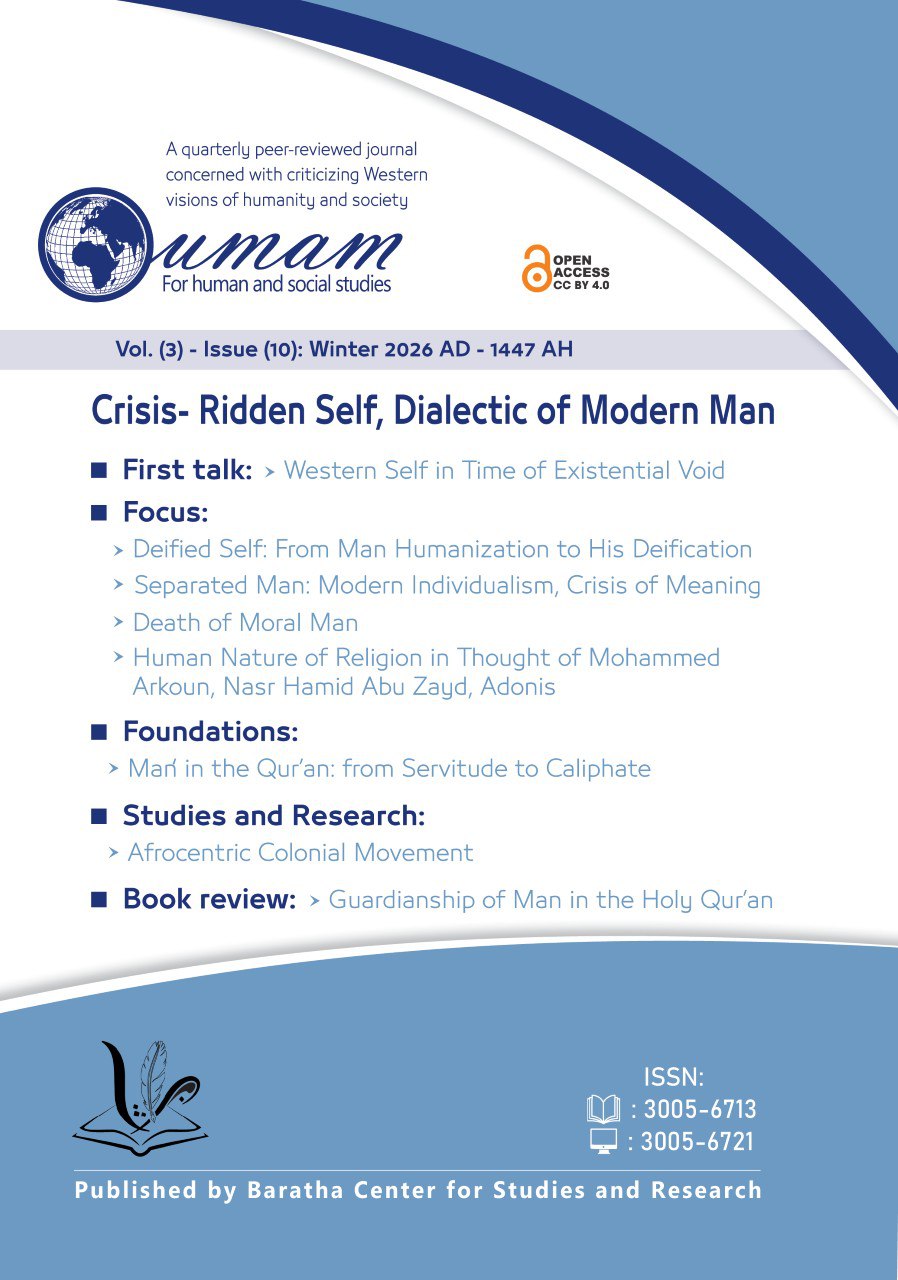
It has evolved from being a theoretical concept confined to philosophy and psychology to becoming the very lens through which knowledge is interpreted, values are evaluated, and the world is restructured. However, this centrality, once celebrated as the ultimate expression of human freedom, soon revealed its darker side. The self now appears burdened by its own existence, overwhelmed by an excess of responsibility, and conflicted in its relationship with both the world and itself.
The modern Western self emerged in a historical context that promised complete freedom: freedom from the sacred, from higher authorities, from inherited traditions, and from any power imposed in the name of truth, morality, or purpose. In this perspective, reason appeared as a self-sufficient reference point, capable of creating a fully rational world governed by clear laws, granting humans unprecedented control over nature, society, and history. Yet, what began as a path toward liberation ultimately led to placing the self in an unanticipated position, the position of being the sole reference and sole responsibility in a world gradually stripped of any meaning beyond it.
...It has evolved from being a theoretical concept confined to philosophy and psychology to becoming the very lens through which knowledge is interpreted, values are evaluated, and the world is restructured. However, this centrality, once celebrated as the ultimate expression of human freedom, soon revealed its darker side. The self now appears burdened by its own existence, overwhelmed by an excess of responsibility, and conflicted in its relationship with both the world and itself.
The modern Western self emerged in a historical context that promised complete freedom: freedom from the sacred, from higher authorities, from inherited traditions, and from any power imposed in the name of truth, morality, or purpose. In this perspective, reason appeared as a self-sufficient reference point, capable of creating a fully rational world governed by clear laws, granting humans unprecedented control over nature, society, and history. Yet, what began as a path toward liberation ultimately led to placing the self in an unanticipated position, the position of being the sole reference and sole responsibility in a world gradually stripped of any meaning beyond it.
...To achieve this, the study begins with Greek and Christian philosophy, which established the dichotomy of submission and transcendence. It then explores Descartes' project in establishing the centrality of the self, Kant's emphasis on moral legislation, Nietzsche's declaration of the "Death of God," and his subsequent call for the "Superior Man", culminating in Foucault’s deconstruction of the self within the context of power and discourse. We conclude that these philosophical shifts did not lead to complete freedom, but rather renewed the presence of authority in various forms, through new methods of thinking and influence. This renders the question of humanity always open, with no definitive or final answer.
...In this study, we have attempted to explore its role in the destruction of the human being, reducing them to a mere body devoid of spirit, earning the title of the separated individual. While the relationship between individualism and the separated human being is the central focus of this study, another key aspect is uncovering its influences that shaped its direction and created a barrier between the individual and others. This separation led to the individual's complete detachment from their social identity. This is such as materialistic philosophy, which entrenched a materialistic worldview in Western society with all its negative dimensions; existentialism, which sought to question everything religious and spiritual; and pragmatism, which institutionalized the principle of utility, causing individuals to focus solely on their personal benefit, even at the expense of human values and principles. These are all philosophies and doctrines that nourished individualism and produced the isolated human being.
...Every civilization was known for a specific set of values that contributed to defining its characteristics, until the modern era, or more specifically Western civilization, arrived. At that time, the values associated with it changed in a way that justifies our assertion of the death of moral humanity. This occurred when capitalism, with its utilitarian values, prevailed, elevating it above all other human values. Consequently, humanity was reduced to a being whose identity was defined by its value, and whose value was determined according to the values of market profit.
This research will take a historical approach, showing the most important human values that have been associated with each civilization, ending with the values of Western civilization, under which the world now lives. Then it shows, using the critical analytical method, how the values of utilitarianism, the market, and self-interest that prevailed in our current civilization failed the thinkers of the West, who, at the beginning of the modern era, hoped, and promised themselves and the world, to achieve the highest human values of fraternity, equality, and justice.
...Nasr Hamid Abu Zayd, and Adonis, as an extension of the secular perspective that prioritizes humanism and the centrality of humanity over the centrality of Allah, Almighty. The research demonstrates that these theses share the belief that revelation and religion are historical human constructs, subject to relative understanding and changing interpretations, rather than divine and immutable givens. It outlines the epistemological foundations of secularism, including humanism, secularism, and instrumental rationality, and examines their impact on modern Arab thought. It then explores in detail Arkoun’s thesis on the humanization of revelation, Abu Zayd’s historicism of the Quranic text and the humanization of its meanings, and Adonis’s interpretation of the Quran as a linguistic and literary text stripped of sacredness.
The study concludes that the assertion of the human nature of religion leads to the denial of its sanctity, the dismantling of religious knowledge at its core, and the emptying of revelation from its divine content. This results in an absolute relativism in both belief and legislation, with multiple purposes existing between the divine, the prophetic, and the human, a position that contradicts ...
It is presented as a prior covenant that forms the stable foundation for both religion and ethics, one that remains unchanged despite the passage of time. The discussion then moves to the concept of caliphate, viewing it as the ultimate purpose and cosmic role of humanity. This purpose transcends legal frameworks to include both "ontological guardianship" and the task of cultivating the earth.
It further addresses the issue of predestination and free will by proposing the theory of "the middle path", which upholds human responsibility while acknowledging Allah's absolute sovereignty. In this view, divine commandments are seen as a form of honor and existential training, helping individuals shape themselves through "tests" and the laws of history.
It also establishes a complementary relationship between "reason" as an internal proof and "revelation" as an external proof, rejecting false dichotomies between science and religion. In its conclusion, the paper offers a comprehensive critique of the Western human rights system based on "humanism" and individualism, revealing the philosophical shortcomings of these foundations in comparison to the concept of "dignity" as presented in the Qur'an, both in ...
The movement began to center around African identity, seeking to reposition it within human civilization in light of its marginalization by the West during the colonial period. It claimed to be the origin of the Pharaonic civilization, asserting that it was an African civilization, while denying the Egyptian people's origins and their connection to Pharaonic heritage, and demanding unjust rights against the Egyptian state. This study attempts to answer a central question about
the Afrocentrism, and what are its key claims regarding the so-called "Blackness" of the Pharaonic civilization, considering it an imperialist replacement ideology?
The study is divided into two main sections: the first explores the concept of Afrocentrism and the context of its emergence, while the second delves into the ideological claims of the Afrocentric movement, particularly the allegations about the African roots of the Pharaonic civilization.
...It explores the concept of guardianship [Wilayah] in its two forms: legislative and ontological. The author primarily focuses on ontological guardianship in its specific sense, which is a status granted to certain individuals who have reached a state of closeness to Allah. The most prominent examples of such individuals are the Prophet Mohammad (peace be upon him) and Ahl al-Bayt (peace be upon them).
The book further examines the path that leads to this specific station of guardianship, emphasizing that it is reliant on two main elements: the first is knowledge and understanding, and the second is action and worship. There is no doubt that sincerity is a fundamental condition for attaining this rank in all of its stages. The stronger the sincerity of the servant, the deeper and more profound their rank of guardianship becomes.
It is crucial to note that the author maintains that humans do not possess guardianship in the same realm as the guardianship of Allah, Almighty, neither in parallel nor in succession. Rather, they serve as manifestations of Allah’s beautiful names. Therefore, the actions of the infallible ...



Comments